
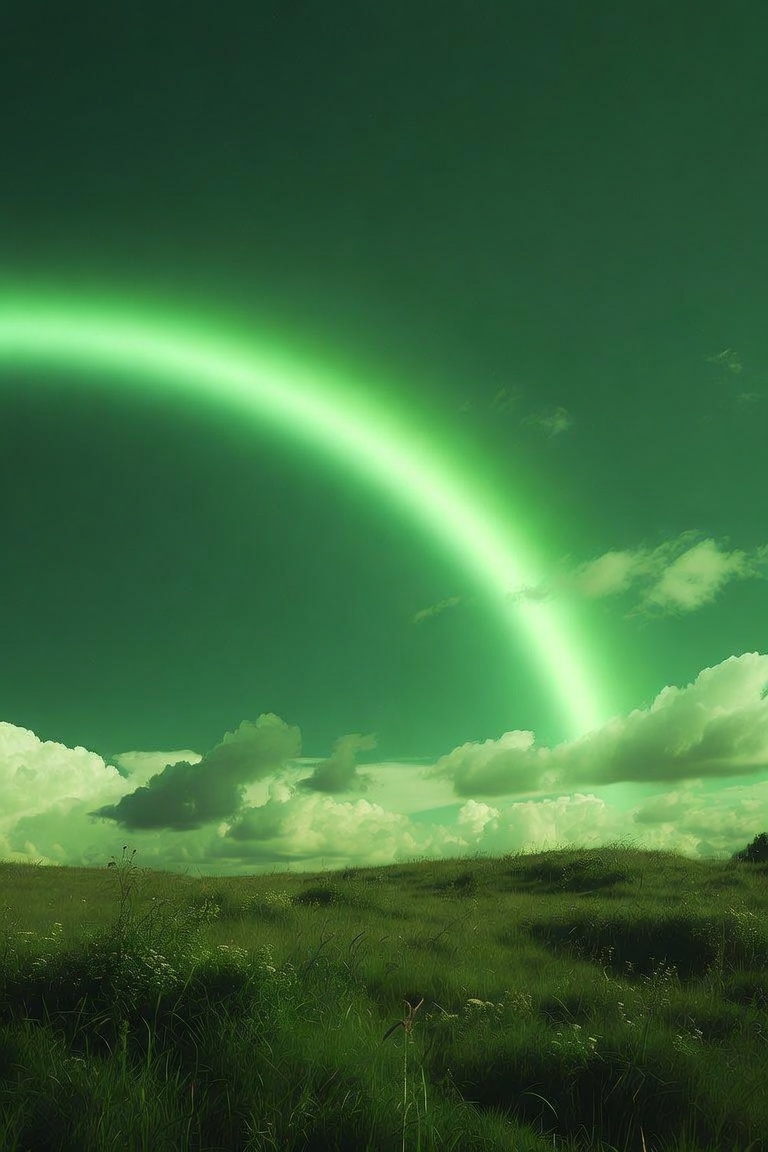
This article explores the biblical references to rainbows, contrasting the familiar multicolored arcs we see after rain with the emerald-like rainbow the apostle John saw encircling God’s throne in Revelation 4:3. A close examination of the original languages shows that the Hebrew term in Genesis 9 (qeshet) literally means “bow” (often referring to a weapon) rather than a specific word for rainbow. Combined with the repeated use of the singular “cloud,” this opens the possibility that God gave Noah a unique, supernatural sign as the token of His covenant.
The study considers whether the bow in Genesis may not have been an ordinary atmospheric rainbow, but something more directly connected to God’s heavenly glory — potentially the same bow John later described. This sign appears to serve as an everlasting reminder primarily to God Himself of His promise never again to destroy the earth by flood. The distinction between everyday rainbows and God’s heavenly bow can enrich our understanding of these passages and highlight God’s faithfulness as a covenant-keeping God.
God’s Emerald Rainbow: A Heavenly Covenant Sign
We are all familiar with the beautiful colors of a rainbow—red, orange, yellow, green, blue, indigo, and violet—that appear in the sky after rain or even from the fine spray of a garden hose on a sunny day. Yet Scripture describes another, distinctive bow, or what is translated, rainbow: the rainbow encircling God’s throne in heaven. In Revelation 4:3, the apostle John records:
“And there was a rainbow round about the throne, in sight like unto an emerald.”
John saw this heavenly bow as resembling the deep green of an emerald. We have never observed an emerald-colored rainbow on earth, yet this is the bow that surrounds God’s throne. Since John was granted a vision of the future, it appears this emerald bow is present around God’s throne even now.
John used the Greek word “iris” (ἶρις) to describe this heavenly phenomenon — a term that translators have rendered as “rainbow.” Notably, he mentions thunder and lightning proceeding from the throne (Revelation 4:5), but says nothing about rain or atmospheric conditions. This suggests that the “rainbow” in Revelation 4:3 may refer primarily to its bow-like shape rather than an ordinary meteorological phenomenon caused by sunlight refracting through water droplets.
The Genesis Covenant Bow
What translators render as “rainbow” appears only a few times in Scripture, but the most significant reference is God’s covenant with Noah after the Flood. In Genesis 9:13-16, God declares:
“I do set my bow in the cloud, and it shall be for a token of a covenant between me and the earth. And it shall come to pass, when I bring a cloud over the earth, that the bow shall be seen in the cloud… And I will remember my covenant… this is the token of the covenant…”
Notice the consistent use of the singular in the Hebrew: “a cloud” and “the bow.” Importantly, the Hebrew does not use a specific word for “rainbow.” Instead, it uses qeshet (קֶשֶׁת), the ordinary word for a bow — most often a warrior’s or hunter’s bow (a weapon). The text also refers to the singular bow being in the singular cloud. This same singular language appears in Ezekiel 1:28, where the glory of the Lord is likened to “the appearance of the bow that is in the cloud on a rainy day.” The Ezekiel passage seems to emphasize the brightness of the bow rather than its colors, “So was the appearance of the brightness round about.”
In Genesis, God sets His bow in the cloud as a visible token of His promise never again to destroy the earth with a flood. Many modern translations, such as the ESV, render the Genesis passage in the plural: “When I bring clouds over the earth, and the bow is seen in the clouds.” This pluralization subtly shifts the meaning toward God’s ongoing control of ordinary weather events. The original Hebrew, however, seems to point toward a particular, one-time divine act. Perhaps God was not necessarily telling Noah that He would continually send everyday clouds and rainbows. Rather, He promised to set a specific bow in a specific cloud as an authenticating sign of His everlasting covenant.
A Supernatural Shekinah Glory Sign for God
From our human perspective, we naturally picture the colorful, post-rain rainbows we see in the sky. But the language and context may suggest that the bow God showed Noah was something different—something supernatural. God instructed Noah and his sons to look for this particular cloud and bow. By placing this sign in the sky, God entered into a covenant with Noah and all creation. The bow was created to serve as a token that God Himself would look upon, so that He would “remember” His promise.
This raises an interesting possibility: Could the bow God placed in the cloud for Noah be the very same emerald rainbow (iris) that John saw surrounding God’s throne? If so, it may well be connected to the Shekinah glory—the visible presence of God—that appeared as a cloud guiding the Israelites through the wilderness and filling the Tabernacle and Temple. If that is the case, what Noah witnessed was no ordinary atmospheric rainbow but a manifestation of God’s heavenly glory brought temporarily to earth as a covenant sign.
An Everlasting Reminder
After the Flood, natural processes of sunlight, moisture, and atmosphere began producing the multicolored rainbows we enjoy today. These earthly rainbows are beautiful and can certainly turn our thoughts toward God’s faithfulness. Yet Scripture indicates that the original bow was given primarily for God, not for man. It is an everlasting reminder to Him of His promise.
Even now, God the Father sits enthroned in heaven, encircled by His emerald rainbow. He sees it constantly. It stands as a perpetual, visible token before Him of His unbreakable covenant with creation—that He will never again destroy the earth by water. This presents a profound picture of divine faithfulness: the same glorious bow that surrounds the throne was once displayed to Noah as assurance after judgment.
This distinction between the ordinary rainbows of our experience and the unique, emerald rainbow of God’s throne can enrich our understanding of Scripture. The very language of the Bible — “bow” (qeshet) in Genesis and iris (translated “rainbow”) in Revelation — encourages us to read God’s Word carefully and literally. It reminds us to allow the text itself—singular nouns, original words, context, and purpose—to shape our interpretation. In both heaven and the historic moment with Noah, God’s rainbow (or bow) proclaims the same unchanging truth: He is a covenant-keeping God.

